AP Workbook Discussion
Chapter 1 (pp. 1 - 6)
This workbook chapter matches up with Chapters 1 - 3 of our textbook mostly. You should look up any of the "Terms to Know" that you are not familiar with in a computer encyclopedia if necessary.
See Figure 2-10 for help with Free-Response Questions #1 on p. 5.
Chapter 2 (pp. 7 - 15)
This workbook chapter matches up somewhat with Chapter 9 of our textbook. You should be able though to use knowledge and experience from having taken a BASIC programming course in the past. Some questions in the Multiple Choice section may have more than one valid answer if you can defend your reasoning.
A lot of the ideas in this section of the workbook require you to have general programming knowledge. You must grasp many "programming tools and concepts" such as top-down programming, bottom-up programming, data management, user interface, error & exception management, program developement with stubs & drivers, program modularity, stepwise refinement, code reuse, and self-documentation. Look them up in other computer science texts or on the Web if necessary.
In your answer to Free-Response Question #2 on p. 12, make sure that you take into account the spaces that must be printed before the first asterisk in each row.
Realize that most programs work in an "initialize, input, process, and output" format (i.e. with regard to the order of tasks) but not ALL of them do. Think broadly when writing pseudocode and designing from top down.
Chapter 3 (pp. 17 - 23)
In Section 1: Multiple-Choice Question #1 on p. 19, the line of pseudocode "Subtract A from B and assign it to the variable A" should be changed to "Subtract B from A and assign it to the variable A"
There is a "best" answer to Multiple Choice #6 on p. 20.
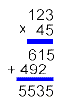
| Free-Response Question #1a. requires you to use repeated addition (within one or more loops) while Free-Response Question #1b. allows you to use multiplication within your algorithm but only between particular digits of the large numbers being multiplied. If you think about the short-hand process that one uses to do multiplication, you can model it with pseudocode to answer this question. | |
Chapter 4 (pp. 25 - 31)
This workbook chapter corresponds mostly with Chapters 4 & 5 of our textbook.
Type casting can be considered explicit casting.
Question #1 on p. 27 (Multiple Choice) is printed incorrectly. The choices should be:
a. int age, numStudents, average;
b. int age, numStudents;
double average;
c. int age;
double numStudents, average;
d. int age, average;
double numStudents;
e. double age, average, numStudents;
Notice that you must assume "integer math" in Multiple-Choice questions #2 & 3 on p. 27. See the instructor if you do not understand integer math (i.e. usually truncating the decimal to store the result in an integer variable.)
Multiple-Choice question #8 can be answered with reasonable programming knowledge and intuition. Study the diagram on p. 28 closely in order to answer the question.
Look up "primitive data type" in your Visual C++ Help menu, in the textbook, or on the Web before you answer Multiple-Choice questions #11 & 12.
Chapter 5 (pp. 33 - 41)
This workbook chapter mainly matches the content in Ch. 8 of our textbook. Read Ch. 18, Section #1 on pp. 382 - 387 and do Exercises 18-1 & 18-2 on pp. 383-387 in your textbook first though to understand the concept of recursion.
Chapter 6 (pp. 43 - 52)
This workbook chapter mainly matches the content in Ch. 9 of our textbook. Reread Ch. 9 in order to refresh your memory on using functions and parameters before completing the exercises in this chapter of the AP workbook. Use your textbook glossary & index, our Web site, and/or the Internet to look up any "Terms to Know" on p. 44 that you do not know. See Mr. Minich if you have any questions about Multiple Choice Questions #5, 6, & 10 on pp. 46 & 47.
Chapter 7 (pp. 53 - 59)
This workbook chapter mainly matches the content in Ch. 6 of our textbook. Reread Ch. 6 in order to refresh your memory on screen input and output before completing the exercises in this chapter of the AP workbook. Use your textbook glossary & index, our Web site, and/or the Internet to look up any "Terms to Know" on p. 54 that you do not know. There will not be a lot of this material on the AP Exam since compilers that different AP students might use vary a bit with regard to how input and output is accomplished in C++.
Chapter 8 (pp. 61 - 71)
This workbook chapter covers material developed through chapters 12 through 14 of our textbook. Refresh you memory on issues and concepts relating to using classes in those chapters before you complete the exercises in this chapter of the AP workbook. Use your textbook glossary & index, our Web site, and/or the Internet to look up any "Terms to Know" on p. 62 that you do not know.
Chapter 9 (pp. 73 - 84)
This workbook chapter matches closely with the material in chapters 13 and 14 of our textbook. Reread these textbook chapters before completing the exercises of this workbook chapter. Use your textbook glossary & index, our Web site, and/or the Internet to look up any "Terms to Know" on p. 74 that you do not know.
Chapter 10 (pp. 85 - 94)
This workbook chapter matches closely with the material in chapters 18 and 19 of our textbook. Reread these textbook chapters before completing the exercises of this workbook chapter. Use your textbook glossary & index, our Web site, and/or the Internet to look up any "Terms to Know" on p. 86 that you do not know.
Chapter 11 (pp. 95 - 100)
This workbook chapter covers the BigInt Case Study which is not mentioned in our textbook. We will discuss this material in class, although there is some material at the AP C++ Web site.
Chapter 12 (pp. 101
We will not be covering this chapter in 1998-99 since we are taking the AP Computer Science A exam, not the AB exam.